Jun 29, 2026
Articles
How to Get a Malta Gaming License in 2026
Learn how to get a Malta gaming license in 2026, from MGA licence types and costs to application steps, share capital and compliance requirements - everything you need is here.

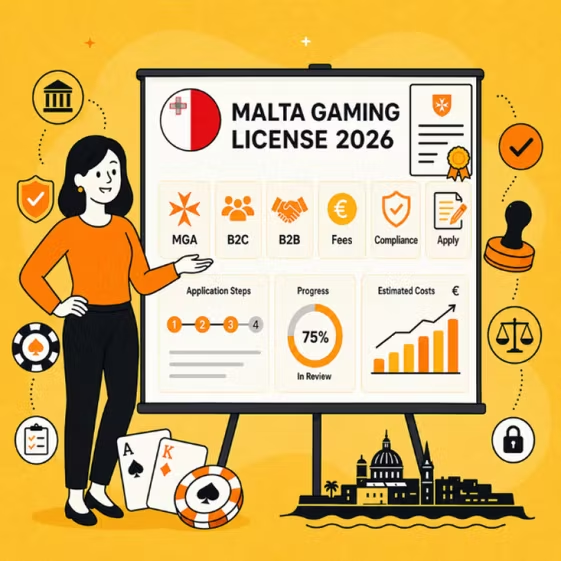
Malta Gaming License Overview
Malta Gaming License 2026: Quick Overview
Why Operators Choose a Malta Gaming License
Malta Gaming Authority and Regulation
Malta Gaming Authority: What Does the MGA Regulate?
Malta Gaming License Types
Malta Gaming License Types: B2C and B2B
Malta Gaming License Game Types
Malta Gaming License Game Types Overview
Eligibility and Requirements
Who Can Apply for a Malta Gaming License?
Malta Gaming License Requirements in 2026
Malta Gaming License Application Process
Application Process Overview
Malta Gaming License Costs
Malta Gaming License Cost in 2026
Malta Gaming License Share Capital Requirements
Timeline and Compliance
How Long Does It Take to Get a Malta Gaming License?
Malta Gaming License Compliance After Approval
Strategic Considerations
Malta Gaming License vs White Label Solution
Common Malta Gaming License Mistakes to Avoid
How to Prepare for a Malta Gaming License Application
Is a Malta Gaming License Right for Your iGaming Business?
Final Thoughts on Getting a Malta Gaming License in 2026
Getting a Malta gaming license remains one of the most recognised routes for operators and suppliers that want to build an iGaming business around a reputable European regulatory framework. Regulated by the Malta Gaming Authority, commonly known as the MGA, Malta has long been viewed as one of the leading jurisdictions for online casino, sportsbook, lottery, poker, fantasy sports and B2B gaming supply businesses.
However, applying for a Malta gaming license in 2026 shouldn't be viewed as some box-ticking exercise. The MGA expects applicants to demonstrate financial stability, transparent ownership, operational readiness, technical reliability, responsible gaming controls, anti-money laundering procedures and the ability to maintain ongoing compliance after approval.
This guide explains how to get a Malta gaming license in 2026, what licence types are available, how the MGA application process works, what costs and share capital requirements apply, and what operators should prepare before submitting an application.
Malta Gaming License Overview
Malta Gaming License 2026: Quick Overview
A Malta gaming license is issued by the Malta Gaming Authority to eligible businesses that want to provide gaming services or critical gaming supply services from Malta, to persons in Malta, or through a Maltese legal entity. The MGA framework distinguishes between two main licence categories: a Gaming Service Licence for B2C operators and a Critical Gaming Supply Licence for B2B suppliers.
In practical terms, a Gaming Service Licence is intended for companies offering gaming services directly to players. This may include online casino games, live casino, fixed-odds betting, peer-to-peer games, poker, betting exchanges, lotteries, secondary lotteries and controlled skill games. A Critical Gaming Supply Licence is intended for B2B companies that supply or manage the material elements of a game, gaming software, regulatory data systems or control systems used by licensed operators.
The MGA’s current licensing model is designed to be more flexible than the older class-based structure. Rather than requiring operators to obtain a separate licence for every game type, licensees can apply for approval to offer additional game types under an existing Gaming Service Licence or Critical Gaming Supply Licence.
Why Operators Choose a Malta Gaming License
A Malta gaming license is attractive because it combines regulatory credibility, a mature iGaming ecosystem and a framework that is familiar to banks, payment providers, game studios, platform suppliers and other commercial partners. For many operators, the main value is not simply the right to operate; it is the trust signal that comes with being authorised and supervised by the Malta Gaming Authority.
Malta is also home to a large network of gaming specialists, including compliance advisors, legal firms, technical auditors, payment providers, platform businesses, hosting providers and experienced iGaming professionals. This makes it easier for operators to build an operational base around the licence, rather than treating licensing as a purely administrative process.
The strongest benefits of a Malta iGaming license include:
A reputable European regulatory framework.A clear distinction between B2C and B2B licensing.Recognition among banks, payment providers and commercial partners.A flexible structure for multiple game verticals.A mature iGaming services ecosystem.Strong player protection, responsible gaming and AML expectations.A licence term that can support long-term regulated growth.
That said, a Malta gaming license should not be presented as an automatic passport into every European market. Online gambling rules remain highly jurisdiction-specific. Operators must assess the laws of each target market and ensure their products, advertising, payment flows and player terms comply with the countries they intend to serve.
Malta Gaming Authority and Regulation
Malta Gaming Authority: What Does the MGA Regulate?
The Malta Gaming Authority is the regulator responsible for gaming activities in and from Malta. Its framework covers both land-based and remote gaming, although this article focuses on remote and online gaming.
For online operators and suppliers, the MGA is especially concerned with whether the applicant can operate transparently, protect players, prevent financial crime, maintain accurate records and keep its technical systems aligned with the documentation submitted during the application process.
The MGA regulatory framework is built around the Gaming Act, subsidiary regulations and a series of directives covering authorisations, compliance, player protection, commercial communications, licence fees, gaming tax and related obligations.
For applicants, this means the licence application is not judged only on the commercial opportunity. The MGA will also assess the people behind the business, the company structure, source of funds, business plan, policies, procedures, technical setup, risk controls and ability to comply after launch.
Malta Gaming License Types
Malta Gaming License Types: B2C and B2B
The first major decision is whether the business needs a Gaming Service Licence, a Critical Gaming Supply Licence, or potentially both.
Gaming Service Licence: B2C Malta Gaming License
A Gaming Service Licence is a business-to-consumer licence. It is designed for companies that offer or carry out gaming services directly to players.
This is the licence category most relevant to online casino operators, sportsbook operators, lottery operators, poker operators and other businesses that manage the customer relationship with players. A B2C operator is generally responsible for the player account, wallet, KYC process, responsible gaming tools, terms and conditions, customer complaints, player fund reporting and gaming tax obligations.
Critical Gaming Supply Licence: B2B Malta Gaming License
A Critical Gaming Supply Licence is a business-to-business licence. It applies to companies that supply or manage critical elements of gaming activity, such as game software, systems that generate or process essential regulatory records, or the control systems on which that software resides.
This licence is particularly relevant for platform providers, game suppliers, sportsbook technology providers, back-office providers and other B2B companies whose products or systems are materially involved in the regulated gaming operation.
Malta Gaming License Game Types
Malta Gaming License Game Types Overview
The MGA groups gaming verticals into four main game types for licensing, share capital and compliance contribution purposes.
Type 1 Malta Gaming License
Covers casino-style games played against the house where the outcome is determined by a random number generator.
Type 2 Malta Gaming License
Covers fixed-odds betting, including live betting.
Type 3 Malta Gaming License
Covers peer-to-peer and commission-based gaming models.
Type 4 Malta Gaming License
Covers controlled skill games such as fantasy sports.
Eligibility and Requirements
Who Can Apply for a Malta Gaming License?
A Malta gaming license can generally be applied for by eligible companies established in Malta, the EU or the EEA, but eligibility goes far beyond simple geographic presence. The Malta Gaming Authority expects applicants to demonstrate that they are structured, funded and managed in a way that supports a compliant and sustainable gaming operation. This means that companies must not only be legally incorporated in an acceptable jurisdiction, but also be able to clearly show who owns and controls the business, how it is financed, and how it intends to operate within the regulatory framework. Applicants should be prepared to provide detailed information about shareholders, ultimate beneficial owners, directors and key personnel, as well as evidence that these individuals have the experience, integrity and financial standing required to operate within a regulated gaming environment.
Malta Gaming License Requirements in 2026
Most Malta gaming license applications require evidence across several core areas, and these requirements are designed to ensure that only well-prepared and credible businesses are granted approval. The MGA does not assess applications based solely on commercial potential; instead, it evaluates whether the applicant can operate responsibly, transparently and in full compliance with regulatory expectations over the long term. This means that applicants must present a cohesive and well-documented picture of their business, covering corporate structure, financial planning, operational controls and technical infrastructure, all of which must align with the licence type and gaming activities being proposed.
Corporate Structure and Ownership
Applicants must demonstrate a clear and transparent ownership structure that allows the MGA to fully understand who ultimately controls the business and how decisions are made. This includes providing detailed information about shareholders, group entities and any arrangements that may influence control or financial flows. Complex structures are not necessarily a barrier, but they must be fully disclosed and logically explained, as any ambiguity or lack of transparency can lead to delays or rejection during the review process.
Fit and Proper Checks
The MGA conducts thorough fit and proper checks to assess whether the individuals behind the business are suitable to operate within the gaming sector. This involves evaluating their professional background, financial standing, reputation and regulatory history, as well as verifying that they have not been involved in activities that could undermine the integrity of the gaming industry. These checks are a critical part of the application process, as the regulator must be confident that the people responsible for the business can uphold the standards required for player protection, financial transparency and lawful operation.
Business Plan and Financial Forecasts
Applicants must submit a detailed and realistic business plan that outlines how the company intends to operate, generate revenue and grow over time. This includes financial forecasts, market analysis, product strategy and operational planning, all of which should be supported by credible assumptions and data. A strong business plan not only demonstrates commercial viability but also shows that the applicant has a clear understanding of the regulatory environment and the responsibilities that come with holding a Malta gaming license.
Operational Policies and Procedures
Operational policies must cover key areas such as anti-money laundering, know-your-customer procedures, responsible gaming, fraud prevention and customer protection. These policies should not be generic templates but tailored documents that reflect the actual processes the business will use in practice. The MGA expects applicants to show that they have robust systems in place to manage risk, protect players and comply with regulatory obligations, and that these systems are integrated into the day-to-day operation of the business.
Technical Setup and Systems Documentation
Applicants must provide comprehensive documentation of their technical infrastructure, including system architecture, gaming platforms, control systems and data management processes. This documentation should clearly explain how the gaming operation will function, how data will be recorded and reported, and how the system will ensure fairness, security and compliance. The technical setup must align with the information provided in the application, as inconsistencies between documentation and implementation can create significant issues during the review and audit stages.
Malta Gaming License Application Process
Application Process Overview
The process includes preparation, submission, review, audit and approval.
Step 1: Choose the Correct Malta Gaming License Type
Determine licence category and game types.
Step 2: Prepare Documentation
Prepare corporate, financial and technical documentation.
Step 3: Submit Application
Submit via the MGA Licensee Portal.
Step 4: Fit and Proper Assessment
MGA evaluates applicant suitability.
Step 5: Business and Operational Review
MGA reviews plans, policies and systems.
Step 6: System Audit
Technical systems are tested and verified.
Step 7: Licence Issue and Go-Live
Licence is granted and operations begin.
Malta Gaming License Costs
Malta Gaming License Cost in 2026
Costs depend on licence type and revenue.
Malta Gaming License Application Fee
€5,000 one-time application fee.
B2C Malta Gaming License Annual Fees
Typically €25,000 annually.
B2B Malta Gaming License Annual Fees
Range from €25,000 to €35,000 depending on revenue.
Malta Gaming Tax and Compliance Contribution
Based on gaming revenue and activity.
Malta Gaming License Share Capital Requirements
Minimum capital depends on licence type and game category.
Timeline and Compliance
How Long Does It Take to Get a Malta Gaming License?
Timelines vary depending on preparation and complexity.
Malta Gaming License Compliance After Approval
Ongoing compliance includes reporting, audits and regulatory obligations.
Strategic Considerations
Malta Gaming License vs White Label Solution
Operators must decide between direct licensing and platform-based entry.
Common Malta Gaming License Mistakes to Avoid
Avoid poor documentation, unclear structures and weak compliance planning.
How to Prepare for a Malta Gaming License Application
Preparation includes documentation, planning and compliance readiness.
Is a Malta Gaming License Right for Your iGaming Business?
The licence suits operators seeking long-term regulated growth.
Final Thoughts on Getting a Malta Gaming License in 2026
A Malta gaming license remains one of the strongest regulatory options for serious iGaming operators and suppliers in 2026. It offers credibility, structure and access to a mature gaming ecosystem, but it also requires careful preparation and ongoing regulatory discipline.
Operators that want to apply should begin by defining the correct licence type, confirming their game verticals, preparing their company structure, building a detailed business plan, documenting their technical setup and ensuring that compliance is embedded before launch.
The businesses most likely to succeed are those that treat the Malta gaming license not as a badge, but as a complete operating framework for building a sustainable, trusted and regulation-ready iGaming brand.