Oct 29, 2026
Articles
How to Get a Curaçao iGaming Licence
Learn how to get a Curaçao iGaming licence, including CGA requirements, application steps, official fees, review periods and market-access limits.


Curaçao gaming license overview
Which Curaçao iGaming licence do you need
Curaçao gaming licence requirements
How to apply for a Curaçao iGaming licence
1. Establish your company and market plan
2. Assemble the application documents
3. Register with the CGA and submit
4. Prepare the operation for assessment
5. Complete the regulatory review
How much does a Curaçao gaming licence cost
How long does a Curaçao iGaming licence take
Which markets can a Curaçao gambling licence serve
Keeping your Curaçao gaming licence compliant
To get a Curaçao iGaming licence, operators must apply to the Curaçao Gaming Authority (CGA), establish an eligible local company and demonstrate that their business meets the jurisdiction’s financial, technical and player-protection requirements.
A licensing application is a revealing account of a business. The ownership chart has to show who really controls it, while the funding declaration must explain how it will keep operating and pay its players. Those answers need evidence that survives a second look. Preparing them is where the work begins.
Curaçao gaming license overview
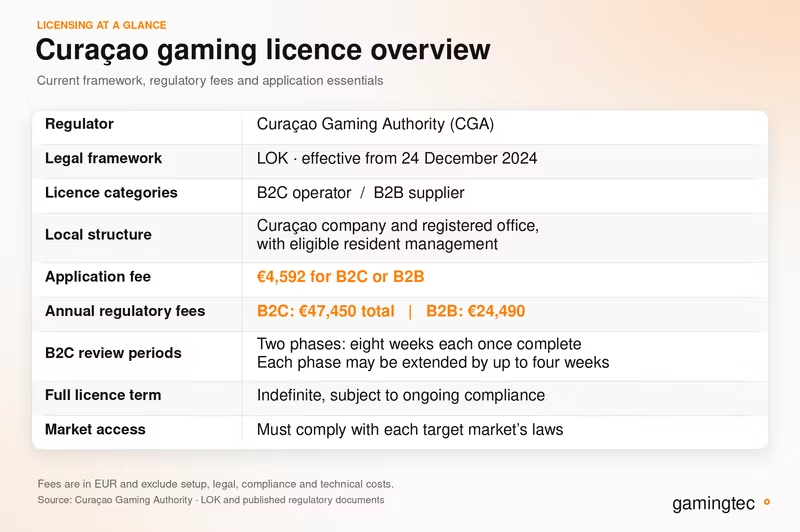
The National Ordinance on Games of Chance, usually called the LOK, took effect on 24 December 2024. It introduced the framework for direct licensing under the CGA, replacing the former master-licence and sublicensing model.
The difference is important when assessing new launch proposals. A new application should follow the current CGA process; offers built around the old sublicence arrangements deserve careful scrutiny. An operator also needs a lawful route into each intended market. Curaçao’s permission to conduct remote gambling does not dispense with another country’s licensing rules.
Which Curaçao iGaming licence do you need
The framework distinguishes between B2C operator licences and B2B supplier licences. A business offering gambling directly to players needs the B2C route. Providers of critical gambling services or goods fall within the supplier framework, depending on their activities.
Casino games, sports betting and poker belong within the broader remote-gambling framework, with the proposed activities disclosed in the application. Supplier permissions and operator permissions serve different purposes, so establish which entity performs each function before choosing the application route.
Curaçao gaming licence requirements
The applicant must be incorporated under Curaçao law and have its registered office there. Local management is also required: the legislation provides for a resident natural-person director or an eligible Curaçao corporate director with resident management.
Expect detailed scrutiny of beneficial owners, qualifying interests and key personnel. The CGA’s corporate information form asks for the ownership structure, funding evidence and a business plan with a three-year forecast. Personal disclosures cover identity, professional history and relevant financial or criminal matters.
Operational preparation deserves equal attention. AML and customer-verification procedures, responsible gambling controls, complaints handling and secure technology must work together. When evaluating an iGaming software provider, ask how those obligations translate into the platform’s everyday behaviour.
Player protection should be visible in the product. The CGA’s responsible gambling policy requires deposit-limit tools and self-exclusion arrangements. Its AML policy addresses customer due diligence and ongoing transaction monitoring. Plan who reviews an unusual payment, who acts on a self-exclusion request and how those actions are recorded.
How to apply for a Curaçao iGaming licence
1. Establish your company and market plan
Define the products, target territories and corporate structure before commissioning the application. Incorporate the Curaçao company and arrange appropriate local management. Obtain jurisdiction-specific advice on the markets you intend to serve, including any local operator and supplier approvals.
2. Assemble the application documents
Prepare the gaming application, Business and Corporate Information Form and the required Personal History Disclosure Forms. Supporting material includes incorporation records, ownership diagrams, funding evidence and the business plan. Follow the personal disclosure form’s document instructions for certified identity documents, address evidence and police records. Inconsistent names or unexplained funding can turn an otherwise orderly application into prolonged correspondence.
Give the application a final consistency check. The ownership chart should agree with the share register, the forecast should reflect the proposed operation, and funding explanations should lead to supporting records. Treat the submission as one account of the business, even when several advisers contribute to it.
3. Register with the CGA and submit
Use the CGA’s new-applicant registration page and follow the licensing department’s instructions for the portal and submission. Registration itself does not confer permission to operate. Submit the required information and pay the application invoice; the authority’s fee policy states that processing begins only after full payment.
4. Prepare the operation for assessment
Document the platform, hosting arrangements, payment flows and game suppliers. Check the applicable testing and certification requirements. Gamingtec's turnkey iGaming solution brings player management, payments and back-office functions into one platform, allowing operators to plan their technology alongside the application. The operator remains accountable for its own regulatory obligations.
5. Complete the regulatory review
The B2C assessment has two phases. The first examines integrity and financial viability; the second addresses the remaining licensing requirements. Answer information requests fully and within the stated deadlines. Where permitted, a provisional licence may be issued during phase two, with outstanding conditions still to satisfy. Approval, payment and the formal grant are distinct stages; confirm the permissions actually issued before accepting players.
How much does a Curaçao gaming licence cost
The CGA’s published LOK fee schedule sets out the regulatory charges:
| Regulatory charge | Published amount |
| B2C or B2B application | €4,592 one-off |
| Annual B2C licence fee | €24,490 |
| Annual B2C supervisory fee | €22,960 |
| Total annual B2C fees | €47,450 |
| Annual B2B supervisory fee | €24,490 |
| UBO or qualifying-interest assessment | €150 per person |
For a B2C applicant, the application fee plus a full year’s standard annual charges comes to €52,042, before individual assessments or other expenses. Initial annual fees are generally calculated pro rata for the year of issuance under the published schedule.
Budget separately for incorporation, local management, legal advice, compliance staffing, testing, hosting and platform costs. A headline licence price rarely describes the full investment required to run the business. Tax treatment also needs its own assessment; the regulatory fee table does not determine the company’s tax position.
How long does a Curaçao iGaming licence take
For B2C applications, Article 5.1 of the LOK provides an eight-week decision period for each phase once the required information is complete, with a possible four-week extension per phase.
Those periods should inform your planning alongside company formation, document preparation and responses to further requests. They do not establish a guaranteed launch date. Keep the regulatory timetable separate from the platform deployment schedule when setting expectations with investors and commercial partners.
Which markets can a Curaçao gambling licence serve
A Curaçao gambling licence must be assessed against the rules of every target territory. Where a country requires its own authorisation, the Curaçao licence alone does not satisfy that requirement. The CGA’s operator conditions expressly require compliance with the laws of the jurisdictions where gambling is offered.
Start with the markets your business can lawfully enter, then confirm supplier availability and payment acceptance for that particular operation. An attractive audience on a market-size chart becomes commercially relevant only when you have established how you can serve it.
Keeping your Curaçao gaming licence compliant
Full licences are granted for an indefinite period, subject to compliance and possible suspension or withdrawal. Annual fees and supervision continue. The CGA’s licence conditions address segregated player funds, reporting, certified games and approval of specified business changes.
The authority’s September 2026 operations-manual guidance also requires an up-to-date account of how the operation works and is controlled. Build that discipline into daily operations, with clear responsibility for maintaining the evidence. The main takeaway is for operators considering a Gamingtec turnkey platform, the conversation starts with the intended markets, operating model and compliance requirements.