Apr 30, 2026
Articles
What Is a Social Casino? Free-to-Play Casino Games Explained
Social casinos combine casino-style games, virtual currency and social mechanics to create free-to-play experiences. Here is how they work and why operators are paying attention.

What Is a Social Casino?
How Do Social Casinos Work?
What Games Can You Play in a Social Casino?
Social Casino vs Real-Money Online Casino: What Is the Difference?
How Do Social Casinos Make Money?
Why Are Social Casinos Popular?
Do Social Casinos Need a Gambling Licence?
What Social Casinos Mean for Operators
Social Casino Trends to Watch
Final Thoughts
What Is a Social Casino?
A social casino is an online platform where players can enjoy casino-style games using virtual currency instead of having to part with real-money wagers. These games often look and feel familiar, with slots, poker, blackjack, roulette, bingo and other casino formats, but the player is usually spending coins, chips, credits or tokens rather than cash.
The important distinction is with redemption. In a traditional social casino, virtual winnings cannot be withdrawn as real money. Players may be able to buy more coins, collect daily rewards, unlock features or compete with friends, but the core experience is built around entertainment rather than gambling for cash prizes.
That difference has made social casino games a significant part of the wider iGaming and mobile gaming landscape. They borrow the rhythm, visuals and excitement of casino play, then combine it with social features, gamification and free-to-play monetisation. For operators, suppliers and platform providers, the model is worth understanding because it sits close to casino, casual gaming, loyalty and player engagement strategy.
How Do Social Casinos Work?
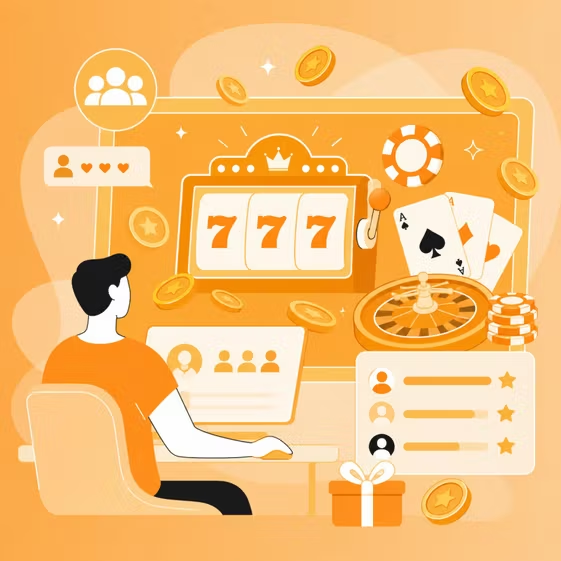
As previously stated, social casinos usually follow a free-to-play model. A new player registers, receives a starting balance of virtual currency and uses that balance to play casino-style games. If they win, their virtual balance increases. If they lose, they can wait for a daily refill, complete a task, watch an advert, invite friends or buy more virtual currency through an in-app purchase.
This creates a loop that feels familiar to anyone who has played mobile games. There is a starting reward, a reason to return, a progression system and a way to keep playing if the player wants more time in the game.
A typical social casino platform may include:
- Welcome coins for new users
- Daily login rewards
- Slots, poker, blackjack, roulette, bingo and instant games
- Virtual coins, chips, tokens or credits
- Tournaments and leaderboards
- Friend invites, gifting and chat features
- Missions, levels, badges and achievements
- Optional in-app purchases
- Ad-supported rewards or sponsored content
The result is a casino-style experience shaped by mobile gaming design. The player is not only spinning reels or playing cards. They are collecting, progressing, competing, returning and interacting with other players.
For operators looking at wider product architecture, social casino mechanics can sit naturally alongside complete iGaming solutions, especially when the goal is to build stronger engagement around casino content, loyalty tools and player retention.
What Games Can You Play in a Social Casino?
Most social casino games are digital versions of familiar casino formats. The most common examples are slots, video poker, blackjack, roulette, baccarat, bingo and poker. Some platforms also include scratch cards, wheel games, crash-style games, instant win titles or casual mini-games that use casino mechanics without looking exactly like a traditional casino product.
Slots tend to dominate because they work well with short sessions, visual rewards, bonus rounds and progression systems. Poker also has a natural place in social casino gaming because it already includes community, competition and status. A player can sit at a virtual table, challenge friends, join a tournament or climb a ranking system without staking real money.
The game selection also depends on the audience. Some social casino platforms are designed for casual players who want quick entertainment. Others lean more heavily into casino realism, with polished graphics, themed slots, multiplayer rooms, table games and VIP-style experiences.
This is where platform flexibility becomes important. A strong online casino platform needs to support content variety, mobile performance, player segmentation and engagement tools, whether the operator is focused on real-money casino, free-to-play experiences, or a broader entertainment ecosystem.
Social Casino vs Real-Money Online Casino: What Is the Difference?
The main difference between a social casino and a real-money online casino is the role of money. In a real-money casino, players deposit funds, place wagers and can withdraw winnings. In a social casino, players use virtual currency for entertainment, and winnings are generally not redeemable for cash.
That difference affects the entire operating model.
| Area | Social casino | Real-money online casino |
| Currency | Virtual coins, chips or tokens | Real-money deposits |
| Winnings | Usually cannot be withdrawn | Can be withdrawn as cash |
| Main purpose | Entertainment and engagement | Gambling with financial stakes |
| Monetisation | In-app purchases, ads, subscriptions, sponsorships | House edge, player wagering, bonuses, payments |
| Player features | Leaderboards, gifting, chat, missions, levels | Bonuses, loyalty, payments, responsible gaming tools |
| Regulation | Varies by market and product model | Requires gambling licensing in regulated markets |
This comparison matters because social casinos can look similar to online casinos at the front end. The games, lobbies, avatars, leaderboards and reward screens may feel casino-adjacent, but the financial structure is different.
The distinction becomes more complex when sweepstakes casinos enter the conversation. A traditional social casino uses virtual currency that cannot be redeemed for cash. Sweepstakes casinos often use a dual-currency system, where one currency is used for entertainment and another may be connected to prize redemption. That creates different legal and operational considerations, so the model needs to be assessed carefully by market.
How Do Social Casinos Make Money?
Social casinos can be free to play and still highly commercial. The most common revenue model is in-app purchases. Players receive free coins to start, but if they run out or want a richer experience, they can buy more virtual currency. Those purchases may be sold as coin bundles, VIP packs, event tokens or premium items.
Advertising is another common revenue stream. Some social casino games offer rewarded video ads, where players watch an advert in exchange for free coins, spins or bonuses. Others may use banners, interstitial ads, branded events or sponsorships.
Subscriptions can also play a role. A player might pay a recurring fee for daily coin drops, exclusive games, ad-free play, faster progression or VIP status. This works especially well when the platform has enough depth to make players feel that regular access has value.
The strongest social casino monetisation strategies usually combine several layers: free access to reduce friction, daily rewards to encourage repeat visits, optional purchases for longer sessions, events and promotions to create urgency, VIP tiers to reward high-value players, and personalised offers based on behaviour.
For operators, the commercial value is not only direct revenue. A social casino can also support audience development, brand awareness, player education, retention and cross-promotion, depending on the wider business model.
Why Are Social Casinos Popular?
Social casinos are popular because they remove the pressure of real-money gambling while keeping many of the features that make casino-style games engaging. Players can spin, compete, collect and progress without the same financial risk associated with cash wagering.
The appeal usually comes from four areas.
First, access is easy. A player can download an app, open a browser game or join through a social platform and start playing quickly. There is no need to understand deposit methods, withdrawal rules or betting limits before the first session.
Second, the experience is low-friction. Free coins, daily bonuses and quick sessions make social casino games feel closer to mobile entertainment than formal gambling.
Third, the social layer changes the emotional rhythm of play. Leaderboards, tournaments, gifting, chat and friend invites add status, community and competition. Players are not only playing against the game; they are playing around other people.
Fourth, progression gives users a reason to return. Levels, badges, missions, unlockable content and seasonal events make the platform feel alive. Gamingtec’s guide to casino gamification strategies explores many of these mechanics in more detail, including missions, leaderboards, tournaments, loyalty systems and player retention.
Do Social Casinos Need a Gambling Licence?
The answer depends on the jurisdiction, the product model and whether anything of real-world value can be won, redeemed or exchanged.
In many markets, a pure social casino may not be treated in the same way as a real-money gambling product because players are not staking cash and cannot withdraw winnings. However, this should never be treated as a universal rule. Regulators may look at the product differently if it includes paid virtual currency, prize redemption, sweepstakes mechanics, loyalty points with real-world value, age-sensitive content or gambling-like design features.
For operators, the safest position is to treat social casino compliance as a market-by-market question. Even if a product does not require the same licence as a real-money casino, it may still need clear terms, age controls, responsible play messaging, data protection processes, consumer protection checks and transparent communication around virtual currency.
The key question is not simply “is this a social casino?” The better question is: what can the player buy, what can the player win, and can anything be redeemed for real-world value?
What Social Casinos Mean for Operators
For operators, social casinos are not only a player-facing entertainment product. They can also be part of a wider acquisition, retention and product strategy.
A social casino can help operators reach players who enjoy casino-style content but are not ready, eligible or willing to play with real money. It can introduce games, mechanics and brand experiences in a lower-pressure environment. It can also create an engaged audience that returns frequently, interacts with promotions and provides useful behavioural data.
From a platform perspective, the most important requirements are flexibility and control. A social casino operation may need game aggregation, player account management, segmentation, bonus tools, content configuration, analytics, CRM integrations and mobile-first performance. If it connects with a broader real-money casino or sportsbook strategy, the platform architecture becomes even more important.
This is where a turnkey iGaming platform can support operators who want to launch with the right mix of casino content, back-office tools, payment integrations, engagement features and operational control, rather than building every layer separately.
Social Casino Trends to Watch
Social casino gaming continues to move closer to the wider mobile entertainment economy. The strongest platforms are no longer built around a static lobby and a list of games. They are becoming more personalised, more social and more event-driven.
Mobile-first design remains essential. Social casino sessions are often short, frequent and habit-based, so the mobile experience needs to feel fast, intuitive and visually polished.
Personalisation is becoming more important. Operators can use player behaviour to recommend games, tailor offers, trigger rewards and shape the lobby experience around individual preferences.
Gamification is becoming more sophisticated. Simple daily bonuses are now joined by missions, quests, streaks, levels, achievement systems, collection mechanics and seasonal events.
Community features are becoming a stronger retention tool. Tournaments, teams, chat, gifting and multiplayer formats can make a platform feel less transactional and more communal.
Regulatory scrutiny may increase as social casino, sweepstakes and real-money models continue to overlap in some markets. Operators need to be precise about currency design, prize redemption, advertising, player protection and data use.
Cross-product strategy is also becoming more relevant. For some businesses, social casino products may support brand engagement, casual gaming, loyalty or market entry. For others, the model may work as part of a wider casino content ecosystem.
Final Thoughts
A social casino is best understood as casino-style entertainment built around virtual currency, social mechanics and free-to-play access. Players get the visual excitement of casino games, the progression loops of mobile gaming and the community features of social platforms, without the standard cash wagering model of a real-money online casino.
For operators, the opportunity is more strategic than it first appears. Social casino mechanics can support engagement, retention, audience development and product diversification. They can also create useful lessons for real-money casino platforms, especially around gamification, personalisation and player lifecycle management.
The operators most likely to succeed in this space will be the ones that treat social casino gaming as a product discipline, not a casual add-on. The games matter, but so do the economy, the reward structure, the user journey, the data model, the compliance framework and the platform behind it.